

Main website:
Other company websites:
Choose website



High-Throughput Security: Weapons Detection for Large Crowds


24 May 2026
High-Throughput Security: Weapons Detection for Large Crowds
How can venues protect large crowds without creating dangerous queues at entry points? Discover how AI-powered X-ray screening helps stadiums, festivals and cultural institutions detect weapons and prohibited items while keeping visitors moving safely and efficiently.
The UK hosts some of the largest and most diverse public gatherings in the world — Premier League and Championship fixtures attended by tens of thousands of supporters, music festivals drawing crowds of 100,000 or more across multiple days, major exhibitions at national museums, international sporting events, and concerts at arenas that fill and empty within a matter of hours. Each of these environments presents a security challenge that is fundamentally different from that of a controlled border crossing or a fixed checkpoint with predictable traffic patterns.
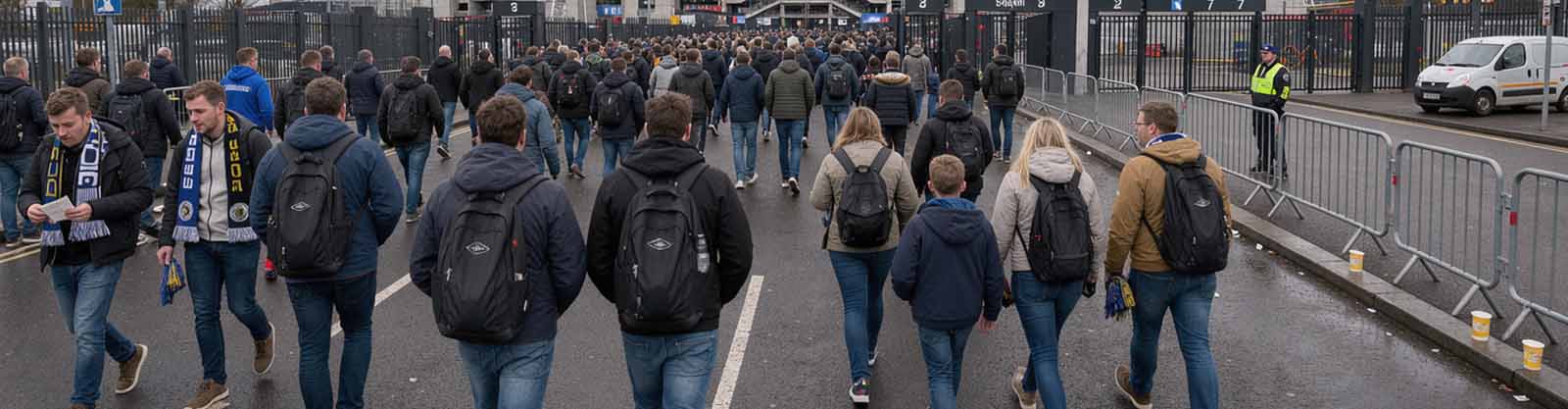
At a public venue, the pressure is not simply to detect threats — it is to detect them without creating the kind of congestion at entry points that itself becomes a safety hazard. A crowd of 60,000 people attempting to enter a stadium through a limited number of entry lanes within a 90-minute window generates an entry flow problem as serious as the screening problem. Security technology that is highly accurate but slow is operationally useless in this context. The requirement is for a weapons detection system for large crowds that delivers both — high detection confidence and the throughput needed to keep people moving.
Why Traditional Entry Screening Falls Short
Walk-through metal detectors and manual bag searches have been the default entry screening method at UK venues for decades. They remain widely used, and in lower-footfall environments they remain adequate. But their limitations become acute as crowd size increases and threat complexity grows.
Metal detectors generate high false positive rates in environments where many attendees carry metal items — keys, belts, coins, jewellery — that are not security threats. Each false positive requires either manual follow-up, adding time and labour, or a threshold calibration that reduces sensitivity enough to let some threats through. Neither outcome is acceptable at scale.
Manual bag searches are slower still, labour-intensive, inconsistent in quality, and dependent on the attention and training of individual security personnel across a full event shift. A security officer conducting manual bag checks at the end of a five-hour entry period is not screening at the same standard as at the beginning. This variability is a structural weakness.
X-ray screening addresses both limitations simultaneously. A baggage X-ray scanner produces a consistent, AI-analysed image of every bag that passes through it, regardless of what shift hour it is or how many bags have preceded it. The AI threat detection engine applies the same classification criteria to the first bag of the day as to the last, identifying weapons, prohibited items, and anomalies without the fatigue-driven degradation that affects human inspection over time.
X-Ray Screening for Personal Belongings at High-Traffic Entry Points
The core application of X-ray technology at venue entry points is the screening of personal belongings — bags, rucksacks, holdalls, and any carried items that cannot be assessed by visual inspection or metal detection alone. A personal belongings scanner configured for high-footfall entry operates on the same imaging principles as airport security screening but is engineered for the specific constraints of venue deployment: variable infrastructure, time-compressed entry windows, and the need for non-specialist operators.
LINEV Systems’ baggage inspection range covers the full spectrum of tunnel sizes and throughput requirements. Compact single-view systems — with tunnel openings from 500 × 300 mm up to 600 × 450 mm — are suited to smaller bag screening at venue entry lanes, festivals, and cultural institutions where the volume of oversized items is low. Mid-range systems with 600 × 800 mm and 700 × 800 mm tunnel dimensions handle standard bag sizes at higher throughput. For venues where large bags, rucksacks, and equipment cases are commonplace — arenas, exhibition centres, major sporting venues — dual-view systems with 1000 × 1000 mm tunnels provide both the capacity and the detection depth needed to screen complex, densely packed bags reliably.
The dual-view configuration is particularly relevant for venue security. Capturing simultaneous projections from two perpendicular angles eliminates the blind spots that single-view imaging creates when objects are packed closely together or when a prohibited item is positioned behind dense material within a bag. For a weapons detection system for large crowds, this geometric completeness is not a marginal improvement — it is the difference between a screen that reliably finds what is hidden and one that can be defeated by basic packing techniques.
All systems in the range integrate AI-powered threat detection software that classifies items in real time, flags anomalies automatically, and reduces the cognitive burden on operators to the point where less experienced personnel can operate effectively with appropriate supervision. This matters for venue security, where staffing is often seasonal, turnover is high, and the window for operator training before each event may be limited.
Body Screening for Weapons Detection at Venue Entry
Bag screening addresses carried items, but it does not cover threats concealed on or within the person. At high-risk events — major political gatherings, high-profile sporting finals, events subject to specific threat intelligence — a complete entry security regime requires body X-ray screening capability alongside baggage inspection.
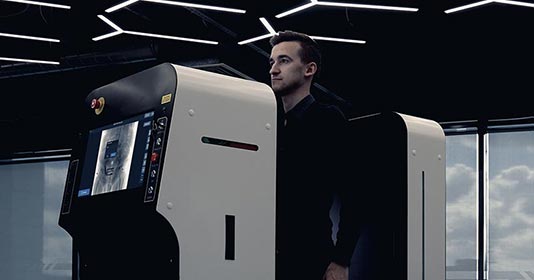
LINEV Systems’ body screening range is designed to address the full range of venue deployment scenarios. For permanent or semi-permanent installations at high-footfall venues, full-body screening systems deliver high-resolution imaging at extremely low X-ray doses — calibrated well within the exposure limits applicable to members of the public — with AI-assisted threat identification that localises anomalies visually on a body map rather than requiring the operator to interpret a raw image.
For venues requiring the fastest possible throughput at body screening points, systems with sub-second scan times allow continuous processing of attendees without creating queue buildups at entry lanes. The AI layer flags items of concern directly, enabling operators to make rapid, informed decisions without slowing the entry flow.
For flexible or temporary deployments — outdoor festivals, events at non-permanent venues, or situations where the threat assessment requires enhanced screening at short notice — portable and compact body screening units provide the same AI-assisted detection capability in a form that can be transported, positioned, and operational quickly without civil infrastructure.
For venues where the entry environment itself needs to be contained — managing radiation boundaries in open-plan or partially enclosed spaces — X-ray shielding cabin configurations provide a self-contained screening environment that simplifies safety compliance and operator positioning.
AI as the Operational Core of Venue Security Screening
The AI capability embedded across LINEV Systems’ body and baggage screening platforms is not a supplementary feature — it is the mechanism that makes high-throughput screening operationally viable at venue scale.
In baggage inspection, the AI threat detection engine analyses each scan in real time and generates automated alerts for items matching the threat signatures it has been trained to identify: weapons, bladed articles, prohibited substances, and anomalies that warrant operator review. The system prioritises and highlights these findings within the operator’s field of view, reducing the time between scan completion and decision.
For narcotics detection — relevant at festivals and large outdoor events where substance use and trafficking present a consistent challenge — automated detection software analyses X-ray projections for characteristics consistent with controlled substances, supporting security and law enforcement teams without requiring specialist operator training for every deployment.
In body screening, AI produces localised visual evidence of detected anomalies, identifying where on the body an item of concern is located rather than generating a simple pass/fail alert. This specificity reduces unnecessary secondary searches, improves the experience for attendees who are cleared quickly, and focuses enhanced attention precisely where it is warranted.
The remote monitoring capability available across the platform — which supports preventive maintenance through real-time system telemetry — also has operational value in multi-lane venue deployments, where a single technical failure at an entry lane during peak entry can have disproportionate consequences for crowd flow and safety.
Venues and Applications
Stadiums and sports venues present the highest-volume, most time-compressed entry challenge in the UK venue security landscape. The combination of fixed kick-off times, concentrated entry windows, and large attendee numbers makes entry flow one of the primary security planning constraints. X-ray screening integrated into stadium entry lanes — combining baggage screening with AI-assisted body scanning — addresses the dual requirement for detection reliability and throughput speed. LINEV Systems works with stadium operators and their security providers to configure systems appropriate to the specific entry architecture of each venue. More on X-ray security solutions for stadiums.
Festivals and outdoor events require a different configuration approach. Without permanent infrastructure, systems must be transportable, rapid to deploy, and capable of operating in variable weather conditions. The diversity of attendees and the multi-day nature of many events also creates specific challenges around staff consistency and screening continuity. LINEV Systems’ portable and compact screening platforms are designed to address these constraints, providing capable weapons detection without requiring fixed installation. More on X-ray screening for public events security.
Museums and cultural institutions present a different operational profile: lower peak volumes than major sporting venues, but a consistent daily throughput across opening hours, a visitor demographic that includes families and international tourists, and a strong institutional priority on visitor experience alongside security effectiveness. Compact, lower-profile baggage screening configurations — with AI threat detection providing reliable coverage without requiring large operator teams — are well matched to this environment. More on X-ray security systems for museums and cultural institutions.
Configuring a Complete Entry Security System
Effective weapons detection for large crowds is rarely a single-product decision. The most capable entry security configurations combine baggage screening, body scanning, and AI threat detection in a coherent system designed around the specific entry architecture, expected attendee volumes, and threat assessment of the venue.
LINEV Systems’ UK team works with venue operators, event organisers, and their contracted security providers to specify and deploy complete entry security solutions — from initial needs assessment through system configuration, operator training, and ongoing technical support. Systems are available for permanent installation, medium-term hire arrangements, and event-specific deployments.
For enquiries about entertainment venue X-ray scanners and weapons detection systems for large crowds, contact LINEV Systems UK.