

Main website:
Other company websites:
Choose website




Baggage X-ray scanner in the UK
Advancing security beyond traditional baggage screening
At LINEV Systems, we continue our mission to protect people, infrastructure, and national assets from evolving modern threats. With security challenges in luggage and parcels increasing in complexity, innovation in baggage X-ray screening has become essential.
Driven by advances in AI, intelligent automation, and high-precision imaging, next-generation baggage X-ray machines now provide UK security professionals with faster, more accurate and more reliable tools for everyday operations.
As a trusted manufacturer of X-ray inspection systems, we deliver comprehensive security solutions designed specifically for today’s risks.
Comprehensive baggage scanners from the manufacturer


X-ray baggage inspection for modern threats
Our portfolio of X-ray baggage scanner solutions combines advanced threat detection with intelligent, user-centric system design. Supported by AI technologies, LINEV Systems equipment offers:
- Automated detection and material analysis;
- Faster threat recognition;
- High-throughput screening for busy environments;
- Improved operator efficiency and consistency.
These systems enhance security across airports, ports, government buildings, event venues, correctional facilities, and critical infrastructure — mitigating risks such as illegal weapons, explosives, smuggling attempts, and narcotics trafficking.
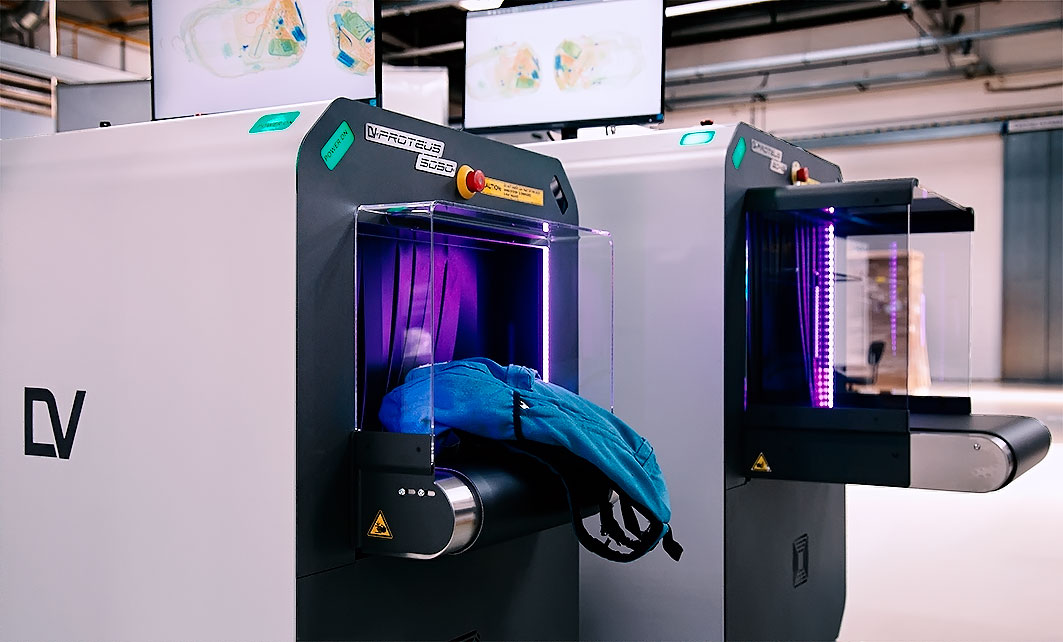
Benefits of modern X-ray baggage scanners

Detecting concealed threats
A modern X-ray baggage scanner can reliably identify concealed items, including firearms, blades, explosives, narcotics, prohibited goods, miniature electronics, and other contraband hidden in bags, parcels, rucksacks, or cargo.

Non-intrusive screening
X-ray screening provides a safe, non-contact inspection method, maintaining passenger comfort while ensuring strict security control without manual bag checks.

Time-efficient operation
High-speed baggage scanners can process multiple items at once, significantly reducing queues in airports, transport hubs, logistics centres and large commercial buildings.

Cost-effective security
By reducing the need for manual searches and enabling fewer operators to manage high volumes of luggage, baggage x-ray machines help lower operational costs over time.

Enhanced detection accuracy
With AI-assisted imaging and material discrimination, X-ray hand baggage inspection systems deliver more consistent and precise identification of suspicious objects compared with traditional inspection methods.
As an established provider of security screening technologies in the UK, LINEV Systems continues to innovate in detection accuracy, reliability and usability.
How to choose the right baggage X-ray machine
01
Application
Define the type of items requiring inspection—hand baggage, large luggage, parcels, mail, or cargo. Different security bag scanner systems are designed for specific use cases.
02
Throughput Requirements
Estimate the volume of bags or parcels to be screened hourly. Choose a baggage x ray scanner that can sustain the necessary flow without causing delays.
03
Image Quality & Software
High-resolution imaging, dual-energy analysis, AI-assisted threat recognition and operator-assist tools significantly improve detection performance.
04
Ease of use
Choose equipment with a clear, intuitive user interface to reduce training time and support efficient system operation.
05
Maintenance and support
Reliable servicing, software updates and long-term technical support ensure operational continuity and extend system lifespan.
06
Integration Capabilities
Modern baggage scanners integrate with access control, video surveillance and automated alarms—an essential component of advanced security ecosystems in the UK.
Where X-ray bag scanners are used
X-ray baggage screening systems are essential across multiple sectors to ensure public safety, regulatory compliance, and efficient threat detection.
Educational Institutions
Used at school entrances to screen bags and possessions of staff, parents and visitors, helping to prevent unauthorised items from entering the premises.
Government Facilities
Deployed in embassies, government offices and courthouses to inspect mail, parcels and visitor belongings for potential threats.
Events & Public Venues
X-ray bag scanners are widely used in stadiums, arenas, concert venues, and other public events to screen personal belongings and ensure attendee safety. This technology helps maintain security during large gatherings and high-profile events by quickly and accurately detecting weapons, explosives, and prohibited items.
Museums & Cultural Institutions
Ensuring the protection of valuable artefacts and preventing the entry of hazardous items or contraband, X-ray baggage scanners are used at museum entrances to screen bags, backpacks, and parcels. These systems help safeguard precious collections and maintain a secure environment for both visitors and staff.
Commercial Buildings
Installed in corporate offices, high-security sites and sensitive operational areas to control access and screen visitors’ belongings.
Transport Hubs
X-ray baggage scanners play a critical role in screening carry-on luggage, checked baggage, cargo and mail.
Correctional Facilities
Used to detect contraband in goods entering prisons and detention centres.
Hospitality Sector
Deployed at hotel entrances and baggage storage areas to enhance guest security.
Military Bases
Used to screen vehicles, equipment and personal belongings for restricted or prohibited items.
These examples demonstrate the wide applicability of baggage X-ray machines across the UK, USA, UAE and other regions, with each deployment tailored to local regulatory and security standards.
FAQ about baggage X-ray scanners
A modern baggage scanner can help identify:
- Firearms, knives and sharp weapons;
- Liquid and composite explosives;
- Illegal drugs and controlled substances;
- Currency smuggling;
- Contraband, counterfeit goods and restricted electronics;
- Hidden or shielded items inside luggage.
Detection capabilities depend on the scanner’s technology, image quality and the characteristics of the inspected items.
When properly installed, maintained and operated, baggage X-ray scanners are designed to meet applicable radiation safety requirements. Safety depends on the equipment’s certification, shielding, interlocks and compliance with the manufacturer’s operating instructions and relevant regulations.
An X-ray generator projects radiation through the object, and detectors measure how much radiation passes through different materials. The system processes this data into an image that operators can examine. Depending on the equipment, dual-energy imaging, multiple viewing angles and AI-based algorithms can help identify suspicious objects.
Pricing depends on:
- System type and intended application;
- Tunnel size and throughput capacity;
- Imaging technology, including single-energy, dual-energy or CT systems;
- Image analysis and AI capabilities;
- Installation complexity and integration requirements;
- Maintenance, servicing and long-term technical support.
Single-view scanners generate an X-ray image from one viewing direction. Dual-view systems use two viewing angles to provide additional information about the contents of a bag. This can help operators assess overlapping objects and reduce the need for manual bag searches, depending on the contents and image quality.
Yes, X-ray scanners can inspect densely packed luggage, but tightly grouped items and overlapping materials may make individual objects harder to distinguish. Image quality, penetration capability, viewing angles and operator expertise all affect the result. If an image is unclear or a potential threat is identified, additional inspection may be necessary.
AI-based image analysis can automatically highlight objects that match predefined threat categories, such as firearms, ammunition, grenades and knives. For example, A-EYE technology can support operators by marking detected objects with visual indicators and category labels. Depending on the system configuration, automated alerts and conveyor controls may also be available. AI provides an additional layer of detection support, but its performance depends on the algorithms, supported threat categories and operating conditions; it does not guarantee that every threat will be identified.
The Terrorism (Protection of Premises) Act 2025, commonly known as Martyn’s Law, establishes proportionate security requirements for qualifying premises and events in the UK. The standard tier generally applies to qualifying premises where 200–799 people may reasonably be expected to be present at the same time, while the enhanced tier generally applies from 800 people, subject to the Act’s specific criteria and exceptions. The law is expected to come into force in spring 2027, with the Security Industry Authority acting as regulator.
Baggage X-ray screening may form part of a venue’s wider security arrangements, particularly where enhanced screening is appropriate to the site’s risk profile. However, the Act does not make X-ray scanners a universal requirement. Venue operators should review the official guidance and assess which measures are proportionate to their premises or event.
X-ray scanners produce images of objects inside bags, which can help operators identify e-cigarettes and vaping devices. AI-based detection may provide additional support where the software is specifically trained and configured to recognise these items. Detection performance depends on the device’s design, how it is packed and the capabilities of the screening system.
This can be useful in schools, educational institutions and other venues with restrictions on vaping. Automated image analysis can help staff identify items for further inspection, but it does not replace applicable search procedures or the venue’s security policy.
Image detail depends on the scanner’s detector resolution, imaging technology, object density and image-processing capabilities. Features such as Smart Zoom can enhance the visibility of small or partially obscured objects by magnifying and processing image details. The available magnification and the degree of detail that can be recovered depend on the specific system.
Image enhancement can make inspection easier, but it cannot recover information that was never captured in the original scan. Operators must still assess the image carefully and request additional screening when necessary.
Yes. Compatible baggage scanners can be integrated into a wider security infrastructure, depending on the equipment’s interfaces and the site’s requirements. Integration options may include centralised monitoring, remote diagnostics, equipment status reporting and connections to other security management systems.
Some solutions also support configurable AI detection functions and monitoring software that tracks system parameters and helps identify faults. Before deployment, operators should confirm compatibility with existing equipment, network security requirements, data protection policies and the manufacturer’s supported integration options.
Some AI-based baggage screening systems can be configured for specific detection tasks or operational environments. The available options depend on the software, supported scanner models and the manufacturer’s validation process. Before deployment, operators should confirm which threat categories are supported, whether customisation or retraining is available, and how updates are tested and maintained.