

Main website:
Other company websites:
Choose website



Engineering Flexibility: Customizable Systems for Critical Infrastructure



Engineering Flexibility: Customizable Systems for Critical Infrastructure
As Martyn’s Law changes security planning in the UK, public venues and critical infrastructure need screening systems that can adapt. This article explores how customizable X-ray screening and AI-driven detection can support safer, more flexible access control.
Security planning for public spaces and critical infrastructure in the UK is undergoing a significant transformation. Rising visitor numbers, evolving threat profiles, and increasing regulatory expectations are changing how operators of transport hubs, stadiums, schools, government buildings, and event venues approach access control.
The introduction of the Terrorism (Protection of Premises) Act 2025, widely known as Martyn’s Law, reflects this shift. The legislation places greater emphasis on preparedness, proportionate security measures, and the ability of venue operators to reduce the impact of terrorist attacks through practical risk mitigation.
For many organisations, the challenge is moving from legal awareness to operational readiness. This transition is explored in greater detail in the article Martyn’s Law and the Reality of Venue Bag Screening, which examines how UK venues can turn public protection guidance into practical, repeatable entrance procedures.
The implementation period also gives organisations an opportunity to reconsider how screening technology fits into their wider protective security strategy. Fixed checkpoint designs that are difficult to upgrade or adapt may become increasingly challenging to operate as procedures, threat assessments, and operational requirements evolve.
For many operators, this is creating demand for customizable X-ray screening solutions that can support changing security policies without requiring repeated infrastructure replacement.
At the same time, organisations must balance security with public accessibility. Long queues, intrusive manual searches, and complex checkpoint procedures can negatively affect the visitor experience, create operational bottlenecks, and increase staffing requirements.
For decision-makers, the challenge is no longer simply installing security equipment. It is building a security architecture that can adapt to changing risks, integrate with existing infrastructure where required, and support long-term operational resilience.
Why Flexibility Has Become a Security Requirement
Security requirements are rarely identical across UK critical infrastructure.
A stadium preparing for a sold-out event, a museum welcoming school groups, a railway station handling continuous passenger traffic, and a government building operating controlled access all face different operational conditions. Yet they increasingly work within the same protective security environment shaped by Martyn’s Law and wider national resilience planning.
As a result, many organisations are moving away from fixed screening architectures towards customizable X-ray screening systems that can be adapted to their own operational models.
A modern customizable and integrated X-ray screening approach is not defined by a single scanner. It is the ability to adapt hardware configurations, AI detection models, software workflows, deployment layouts, and future upgrades to the operational requirements of a particular site.
Integration with existing security infrastructure such as access control, CCTV, pedestrian screening, and remote monitoring platforms can further support long-term operational flexibility where organisations require it.
For operators of transport hubs, public venues, and government facilities, a robust compact X-ray system for critical infrastructure is increasingly viewed as a long-term infrastructure investment rather than a standalone security device.
Engineering Flexibility in Practice
Engineering flexibility is becoming an important design principle for modern security infrastructure.
Instead of replacing equipment whenever operational requirements change, organisations increasingly look for systems that can be adapted through software updates, AI model refinement, modular hardware options, and integration with existing security processes.
Practical examples include:
- different tunnel sizes for different operational environments;
- single or dual generator configurations;
- mobile and plug-and-play deployment;
- AI retraining for location-specific threat profiles;
- remote telemetry and preventive maintenance;
- future software and capability upgrades.
This approach helps protect long-term investments while reducing operational disruption and simplifying future expansion.
One Approach to Adaptive Screening: LV Stream
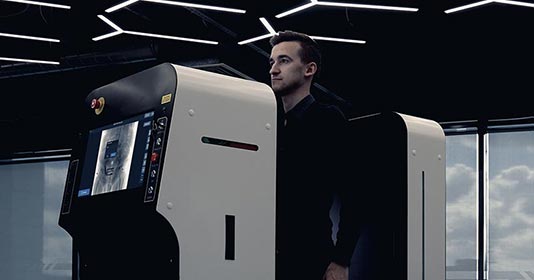
One example of this engineering philosophy is LV Stream, a high-throughput baggage screening platform developed by LINEV Systems for public venues and other high-footfall environments.
The system was designed around many of the operational challenges that UK organisations are currently addressing: maintaining visitor flow, reducing dependence on manual image interpretation, and supporting consistent security procedures under growing regulatory expectations.
By combining Dual-View X-ray technology, A-EYE™ automated threat detection, and a flexible deployment model, LV Stream demonstrates how a customizable X-ray screening solution can support both security and operational efficiency.
Rather than functioning as an isolated scanner, the platform can operate as part of a broader protective security framework and can be integrated with existing checkpoint technologies where required.
This approach aligns with the wider direction of UK protective security planning, where technology is expected to support procedures rather than replace them.
The system processes more than 1300 bags per hour and automatically identifies weapons, disassembled firearms, explosives, flares, vapes, and other prohibited items. Automated threat recognition helps reduce operator workload while supporting efficient visitor movement during peak periods.
Intelligence Software and Configurable Threat Detection
Engineering flexibility extends beyond hardware.
The A-EYE™ artificial intelligence platform and BV THREAT DETECTION software are designed to support automated identification of firearms, firearm components, ammunition, grenades, knives, brass knuckles, explosives, flares, and vaping devices.
An important advantage of the system is its adaptability. Detection models can be trained and refined to recognise specific categories of objects that are relevant to individual operational environments.
For schools, this may include enhanced vape detection capabilities. For event venues, the priority may be weapons and explosives. Industrial sites may require identification of foreign objects or items specific to their security policies.
This ability to deliver customizable X-ray screening allows organisations to align security technology with their own risk assessments rather than relying on a one-size-fits-all approach.
The software also supports automatic conveyor stopping and visual threat highlighting, helping security teams respond quickly while reducing operator workload.
X-LINEView: Extending Operational Flexibility
Maintaining security capability requires more than reliable screening equipment. Operators also need visibility into system health, performance, and maintenance requirements.
X-LINEView provides a telemetry environment that allows organisations to monitor, manage, and optimise installed screening systems through remote software tools.
The platform offers control over more than one hundred operational parameters, AI-assisted data analysis, smart failure notifications, and operator activity monitoring. These capabilities help security managers identify trends, optimise workflows, and address technical issues before they affect checkpoint operations.
A digital twin function creates a virtual representation of the installed system, allowing new configurations and operational scenarios to be evaluated without disrupting live security processes.
Online and offline operating modes provide additional flexibility, while secure integration with existing infrastructure supports centralised management across multiple locations.
X-LINEView further extends this engineering approach by giving operators greater visibility over system performance and maintenance requirements. Together with A-EYE™, it allows screening infrastructure to evolve through software management and data-driven optimisation rather than hardware replacement alone.
Supporting Compliance and Future Security Requirements
Security legislation and operational standards continue to evolve, particularly for publicly accessible locations.
While technology alone cannot ensure compliance with Martyn’s Law or other UK security obligations, adaptable screening platforms can support broader protective security strategies by improving preparedness, increasing screening consistency, and helping organisations implement proportionate protective measures.
The combination of automated threat detection, scalable deployment, software-driven updates, and integration with existing infrastructure allows security investments to remain effective as requirements change.
This reduces the need for repeated large-scale hardware replacement and helps organisations plan security improvements over longer operational cycles.
Operational Benefits for Decision-Makers
For operators of critical infrastructure, engineering flexibility ultimately translates into practical business and security outcomes.
A modular platform can reduce disruption during deployment, simplify future upgrades, and protect previous investments. Automated threat detection helps reduce operator workload and minimise human error. High-throughput processing supports visitor experience while maintaining effective security controls.
Remote monitoring and predictive maintenance improve system availability, while configurable AI models allow security policies to evolve alongside changing risks.
These capabilities help organisations build security strategies that are not only effective today but sustainable over the long term.
As UK protective security requirements continue to evolve, organisations are increasingly evaluating not only how well screening systems perform today, but how effectively they can adapt to future operational demands.
For critical infrastructure, transport facilities, public venues, and government sites, engineering flexibility is becoming a practical requirement rather than an optional feature. Systems that support configurable AI, software-driven upgrades, and adaptable deployment models can help organisations respond to changing threats while protecting long-term investments.
Solutions such as LV Stream illustrate how this approach can be applied in practice, combining high-throughput screening with the flexibility needed to support modern protective security strategies and the operational realities emerging under Martyn’s Law.