

Main website:
Other company websites:
Choose website



X-Ray Baggage Screening on Cruise Ships: How Modern Technology Keeps Passengers and Crew Safe



29 May 2026
X-Ray Baggage Screening on Cruise Ships: How Modern Technology Keeps Passengers and Crew Safe
How can cruise terminals screen thousands of bags efficiently while maintaining a high level of security? Explore how AI-powered X-ray screening supports safer embarkation, faster passenger flow and reliable prohibited-item detection for cruise ships and maritime terminals.
Cruise ships are, by any measure, some of the most complex security environments in the civilian world. A large modern vessel carries between 3,000 and 7,000 passengers alongside a crew of 1,000 or more, operates across multiple international jurisdictions during a single voyage, and functions simultaneously as a hotel, a port of entry, and a self-contained community at sea. The security decisions made at embarkation — before the ship leaves port — set the conditions for everything that follows.
Unlike an airport, where security infrastructure is fixed, standardised, and subject to consistent regulatory oversight by a single national authority, cruise terminal security varies considerably between ports. Southampton, the UK’s primary cruise departure point, operates under established Maritime and Coastguard Agency frameworks and port operator security requirements. But the same vessel that embarks in Southampton may call at a dozen other ports across the Mediterranean, the Caribbean, or the Baltic during its voyage — each with its own terminal configuration, regulatory environment, and baseline security standard.
This variability makes the quality of baggage screening at the point of embarkation particularly significant. Threats that are not identified before passengers and their luggage board the vessel cannot be managed at sea. There is no secondary screening facility, no law enforcement handover option, and no ability to remove a threat without diverting the vessel. The embarkation security checkpoint is, in a meaningful sense, the last opportunity to intercept prohibited items before they enter a closed environment for days or weeks.
What Cruise Ship Baggage Screening Must Address
The range of items that cruise line security teams are required to identify at embarkation is broader than at most other civilian venues. In addition to the standard prohibited items — weapons, bladed articles, and items presenting an immediate safety risk — cruise lines impose their own restrictions governing alcohol quantities, certain electronic devices, and a range of items considered incompatible with shipboard safety, including items with open heating elements, large quantities of flammable materials, and in some cases specific medications requiring declaration.
Cruise ship baggage X-ray screening must therefore support two distinct but related functions: the identification of genuine security threats, and the enforcement of line-specific prohibited item policies that vary between operators and sometimes between voyage types.
Beyond the content of individual bags, the operational context creates its own demands. Embarkation at a major UK cruise terminal may involve several thousand passengers boarding within a four to six hour window before departure. Luggage volumes are substantially higher per passenger than at most other screening environments — a two-week voyage generates a very different packing habit than a day trip to a stadium. Large, densely packed suitcases, rigid cases, and specialist equipment cases are the norm rather than the exception. Screening systems must maintain throughput across this volume without creating the kind of terminal congestion that delays departure.
The Role of X-Ray Technology in Cruise Terminal Security
Modern cruise ship baggage screening relies on X-ray technology as its primary non-intrusive inspection method. Unlike metal detection, which identifies only metallic content and generates high false positive rates in luggage that routinely contains large quantities of metal items, X-ray imaging provides a complete picture of bag contents regardless of material type.
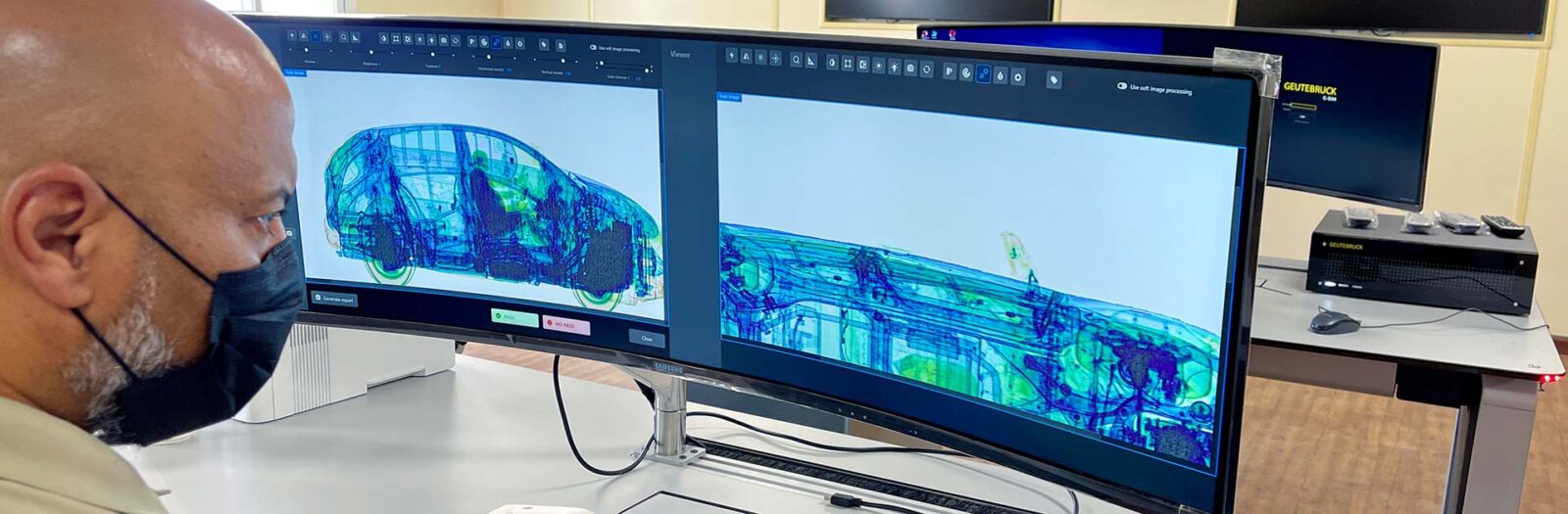
High-energy X-ray systems penetrate dense luggage — including rigid suitcases packed with clothing, equipment, and personal items — and produce detailed images that allow operators and automated detection systems to identify the shape, density, and material characteristics of individual items within the bag. Weapons, prohibited items, and anomalies that would be invisible to metal detection or superficial physical search are rendered visible in the X-ray projection.
For cruise terminal deployment, the most operationally significant capability is AI-powered automatic threat detection. Systems equipped with AI classification engines analyse each scan in real time, flagging items that match the threat signatures they have been trained to identify — weapons, bladed articles, prohibited substances, and anomalies warranting review — without requiring the operator to manually evaluate every image in full detail. In a high-throughput embarkation environment where a single screening lane may process hundreds of bags per hour, this automated first-pass analysis is the mechanism that makes reliable detection achievable without proportionally scaling the operator workforce.
Dual-view baggage scanners provide an additional detection advantage relevant to the specific challenge of cruise luggage. A single X-ray projection captures a two-dimensional shadow of bag contents from one angle. When items are densely packed — as they typically are in holiday luggage — prohibited items can be positioned behind other contents in ways that make them difficult to resolve in a single-view image. Dual-view systems capture simultaneous projections from two perpendicular angles, eliminating the geometric blind spots that single-view imaging creates and improving the AI engine’s ability to classify items correctly when the bag’s contents are complex.
LINEV Systems’ baggage X-ray scanner range covers the tunnel dimensions relevant to cruise terminal deployment. Mid-range systems with 600 × 800 mm and 700 × 800 mm tunnel openings handle standard checked luggage and cabin bags at high throughput. For the oversized cases, rigid trunks, and specialist equipment commonly carried on longer voyages, large-format systems with 1000 × 1000 mm tunnel dimensions — available in both single-view and dual-view configurations — provide the capacity to screen large items without requiring them to be diverted to a separate manual inspection process. For particularly large or irregularly shaped items, wide-tunnel systems extending to 1600 × 1800 mm handle heavy baggage and oversized packages that would otherwise require a separate handling process entirely.
Cabin Baggage and Carry-On Screening
In addition to hold luggage screened at embarkation, cruise ship security regimes typically include screening of carry-on items — hand baggage, personal electronics cases, and items passengers intend to keep in their cabin rather than placing in the hold. The volume and size profile of carry-on items at cruise embarkation differs from that at an airport, where restrictions on liquids and cabin bag dimensions are tightly enforced and passengers are accustomed to the screening process.
At cruise terminals, passengers may carry a considerably wider range of items through the cabin bag screening lane, including items that would not typically be seen in airport cabin baggage. Compact baggage X-ray systems with tunnel dimensions in the 500 × 300 mm to 600 × 450 mm range — appropriate for smaller bags, personal items, and electronics — provide accurate, AI-assisted screening for these items without the footprint of systems sized for checked luggage.
The combination of large-format checked luggage screening and compact carry-on inspection, both AI-equipped and networked to a central operator position, reflects the layered approach to cruise ship baggage screening that major operators and terminal security providers are increasingly adopting.
Crew and Staff Screening
A cruise ship’s crew represents a distinct screening population from the passenger manifest. Crew members board at embarkation, return to the vessel at each port of call, and move between the ship and shore throughout the voyage. They carry personal belongings, consumables, and in some cases specialist equipment related to their role on board.
Effective cruise ship security requires that crew screening is maintained consistently — not only at the initial embarkation but at each subsequent port where crew members disembark and reboard. The volume of individual screenings this generates across a vessel’s complement is substantial, and the operational expectation is that crew access is not materially delayed by the screening process.
Compact, high-throughput baggage screening systems configured for crew access points provide the combination of speed and detection reliability appropriate for this application. AI-assisted automatic threat detection supports consistent screening quality regardless of shift patterns or individual operator experience — relevant for crew access points that may be staffed by security personnel with varying levels of dedicated X-ray screening training.
Integration with Broader Port and Vessel Security Systems
Cruise terminal baggage screening does not operate in isolation. Effective embarkation security integrates X-ray baggage inspection with passenger identification verification, boarding pass validation, and in larger terminals, access control and CCTV infrastructure.
LINEV Systems’ baggage screening platforms support remote monitoring and system telemetry, enabling technical oversight of multiple screening lanes from a central point — relevant for large cruise terminals where a significant number of lanes may operate simultaneously during peak embarkation. Predictive maintenance alerts reduce the risk of lane downtime during an embarkation window where a technical failure has direct consequences for departure schedules.
For cruise lines and terminal operators evaluating or upgrading their baggage screening infrastructure, the combination of AI-powered detection, dual-view imaging across a range of tunnel sizes, and integrated remote monitoring capability provides a complete technical foundation for a compliant and operationally effective cruise ship baggage screening programme.
LINEV Systems UK works with port operators, cruise line security teams, and their contracted security providers to specify systems appropriate to the specific terminal configuration, passenger volumes, and regulatory requirements of each deployment. For more information on baggage X-ray scanners suitable for cruise terminal and maritime security applications, contact LINEV Systems UK directly.